Czech Academic initiative for the rescue of whales and dolphins



Call
The lives of whales and dolphins are at a serious risk.
These extremely advanced animals contribute essentially not only to the preservation of the diversity and balance of species in the oceans and seas, but also to their overall health, spreading positive energy in them. They are vital for the preservation of planet Earth and thus of us all.
Although commercial hunting of these animals has been prohibited since 1986, their killing continues under various exemptions. This means that whaling and dolphin hunting greatly exceeds their reproductive cycles, and there is an imminent danger that the next generation of humans will no longer be able to encounter these magnificent beings.
Let us stop their hunting and extinction right now, protect them as irreplaceable and invaluable sentient beings.
If there are countries that resist this by referring to the preservation of their cultural traditions, it is time to change these traditions, because they no longer belong in today’s world. They harm these animals, and they do not benefit humans themselves.
Also, hunting "for scientific purposes," which leads to the extinction of these species and the devastation of the oceans, is a denial of science itself and its purposes, is inhuman, and must no longer be tolerated.
Therefore, we ask for immediate cancellation of all exceptions and quotas and the unconditional and unreserved termination of hunting of dolphins and whales!
Please, do support this initiative with your vote and become one of the rescuers of these beautiful and exceptional beings.
Your voice will not be lost and will be used within the framework of the procedures foreseen by the European law, including hearings in the European Parliament and other relevant means.


Reasoning
-
Every year, around 300,000 whales and dolphins are killed.
-
Although a moratorium was declared as early as 40 years ago (1986), commercial whaling continues due to certain exemptions and quotas.
-
Japan – efforts to end the moratorium, citing cultural reasons and scientific purposes.
-
Norway – cultural tradition.
-
Iceland – reauthorization until 2029.
-
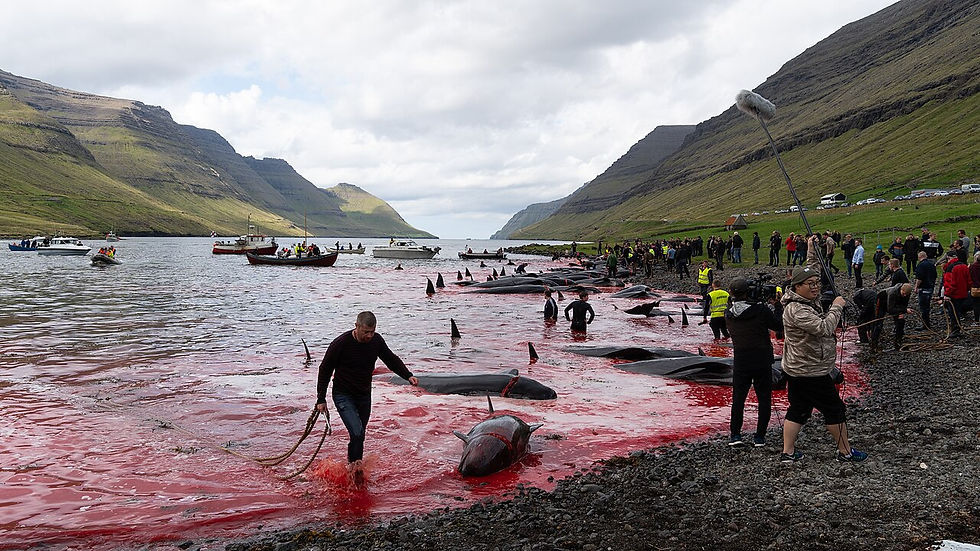
Faroe Islands – part of Denmark (where the ban applies), but the Faroe Islands, which hold a special status, apply an exemption.
-
Greenland – classified as aboriginal subsistence whaling under an exemption until 2031.
-
Alaska – hunting within established quotas.
-
During the hunt, cetaceans are killed in a particularly cruel and torturing manner that lasts from several hours to days.
-
On one hand, the EU quite rightfully adopts legislation regarding the humanization of domestic animal slaughter; on the other hand, the same protection is not granted to these marine animals, whose numbers, unlike domestic animals, we cannot artificially increase.
-
Whale meat is unsuitable for human consumption. It contains large amounts of toxins and can lead to endocrine dysfunction, cancer, and diseases of the kidneys, liver, heart, and immune system.
-
Dolphin meat is considered harmful to health. It contains dangerously high levels of mercury and methylmercury, in Japan even up to 100 times more than the permitted limit.
-
Unlike other climate goals, the implementation of which is associated with large financial investments and economic transformation, nothing similar is needed in the case of dolphins and whales, only a political decision to definitively end the killing of cetaceans is sufficient. It is a cheap and an effective way to save these very valuable animals and prevent the devastation of the seas and oceans.
SIGN FOR RESCUE OF DOLPHINS AND WHALES

About us
This initiative was started by a group of teachers and students at the Palacký University Faculty of Law. It quickly gained the unanimous support of the Faculty's Academic Senate and is now backed by the University leadership as part of our sustainable development goals.
We are also reaching out to others who would like to support this cause—whether you are a student or teacher from another university in the Czech Republic or abroad, a professional from a non-academic institution, or simply an individual who cares. We welcome everyone who isn't indifferent to the fate of dolphins and whales!